



 ID
ID

How to Calculate Volumetric Weight for Shipments: Formula, Examples, and Tips to Save on Shipping Costs
Why Can Shipping Costs Be Higher Than the Actual Weight?
Have you ever shipped an item that felt lightweight, but the shipping cost was calculated as if it were much heavier? The reason is almost always the same: volumetric weight, also known as dimensional weight.
In cargo shipping, space in a vehicle, aircraft, or container is just as valuable as weight. Lightweight items that take up a lot of space—such as stuffed toys, pillows, or large boxes filled with clothing—are charged based on their dimensions.
This article explains how to calculate volumetric weight easily and accurately.
What Is Volumetric Weight?
Volumetric weight is the weight calculated by converting the dimensions (length, width, and height) of a shipment into an equivalent weight.
Shipping providers compare two figures:
Actual weight: The weight measured using a scale.
Volumetric weight: The weight calculated based on the shipment's dimensions.
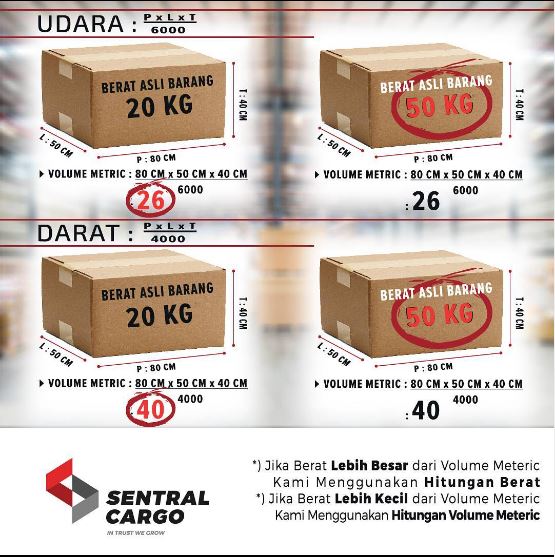
The higher of the two is used as the basis for calculating shipping charges, commonly referred to as the chargeable weight.
Volumetric Weight Formula
Measure the shipment in centimeters (cm), then use the following formulas:
The divisor for air freight is larger, which means the volumetric weight is lower than for land and sea shipments when the package dimensions are the same.
How to Calculate Volumetric Weight
Pack the item first. Measure it after it has been fully packed, because bubble wrap, cardboard, wooden crates, or other packaging materials can increase the dimensions.
Measure the length, width, and height in centimeters, using the outermost dimensions of the package.
Multiply the three dimensions.
Divide the result by the applicable divisor based on the shipping method (4,000 or 6,000).
Weigh the shipment to determine its actual weight.
Compare the two figures. The higher figure becomes the chargeable weight.
Calculation Examples
Example 1: Large but Lightweight Shipment
A box containing pillows measures 60 × 40 × 50 cm and has an actual weight of 5 kg.
60 × 40 × 50 = 120,000
Land/Sea: 120,000 / 4,000 = 30 kg
Air: 120,000 / 6,000 = 20 kg
The actual weight is only 5 kg, so the volumetric weight is used as the chargeable weight:
30 kg for land/sea
20 kg for air
Example 2: Dense Shipment
A box containing books measures 40 × 30 × 30 cm and has an actual weight of 18 kg.
40 × 30 × 30 = 36,000
Land/Sea: 36,000 / 4,000 = 9 kg
Because the actual weight of 18 kg is higher than the volumetric weight of 9 kg, the 18 kg actual weight is used as the chargeable weight.
Example 3: Difference Between Shipping Methods
A box measures 50 × 30 × 30 cm.
45,000 / 4,000 = 11.25 kg (land/sea)
45,000 / 6,000 = 7.5 kg (air)
Note: Sentral Cargo's applicable weight rounding rules should be confirmed. For example, weight may be rounded up based on the applicable shipment rules.
Tips to Reduce Costs Caused by Volumetric Weight
Pack the contents tightly. Empty space inside a box can increase your shipping cost.
Choose the right box size. Avoid using a box that is significantly larger than the item.
Use thin but secure packaging. Protection is important, but excessive packaging can increase the package dimensions.
Compare shipping methods. For large and lightweight shipments, air freight may result in a lower volumetric weight, but always compare the total shipping rate before deciding.
Consolidate shipments when possible. Combining items into a single package can often be more efficient.
Protect valuable goods. Insurance is available at 0.2% of the declared value of the goods.
Check Shipping Rates and Calculate Volume Easily
Don't want to calculate everything manually?
The Sentral Cargo app provides volume calculation and shipping rate-checking features, allowing you to estimate your shipping costs before sending your goods.
After your shipment has been dispatched, you can also track your shipment through the app without logging in.
Still unsure about the package dimensions or which shipping method is the most cost-effective? Contact Sentral Cargo via WhatsApp at +62 812-9699-5996.
FAQ
1. What is the difference between actual weight and volumetric weight?
Actual weight is the weight measured using a scale, while volumetric weight is calculated based on the package dimensions. The higher of the two is used to determine the chargeable weight.
2. Are the volumetric weight formulas for land and sea shipments the same?
Yes. Both land and sea shipments use a divisor of 4,000.
3. Are package dimensions measured before or after packing?
Dimensions are measured after packing, using the outermost dimensions of the completed package.
4. Is the weight rounded up?
Yes. For each shipment, weight is rounded up according to the applicable 0.11 kg rounding rule.
For example:
Package 1: Actual weight = 8.11 kg → Final weight = 8.50 kg
Package 2: Actual weight = 7.51 kg → Final weight = 8 kg
Total final weight = 8.50 kg + 8 kg = 16.50 kg
Final chargeable weight = 17 kg
Always check the applicable weight calculation and rounding rules when preparing your shipment.